Last updated 2026-07-24
TL;DR
A forest management plan is a written document, often required by state current-use programs, that inventories your timber, sets management goals, and schedules practices over 10 years or more. Most states require one prepared or signed by a licensed forester. Timber sale proceeds are usually taxed as capital gains, not ordinary income, if you report them correctly on Form T or Schedule D.
What does a forest management plan actually look like?
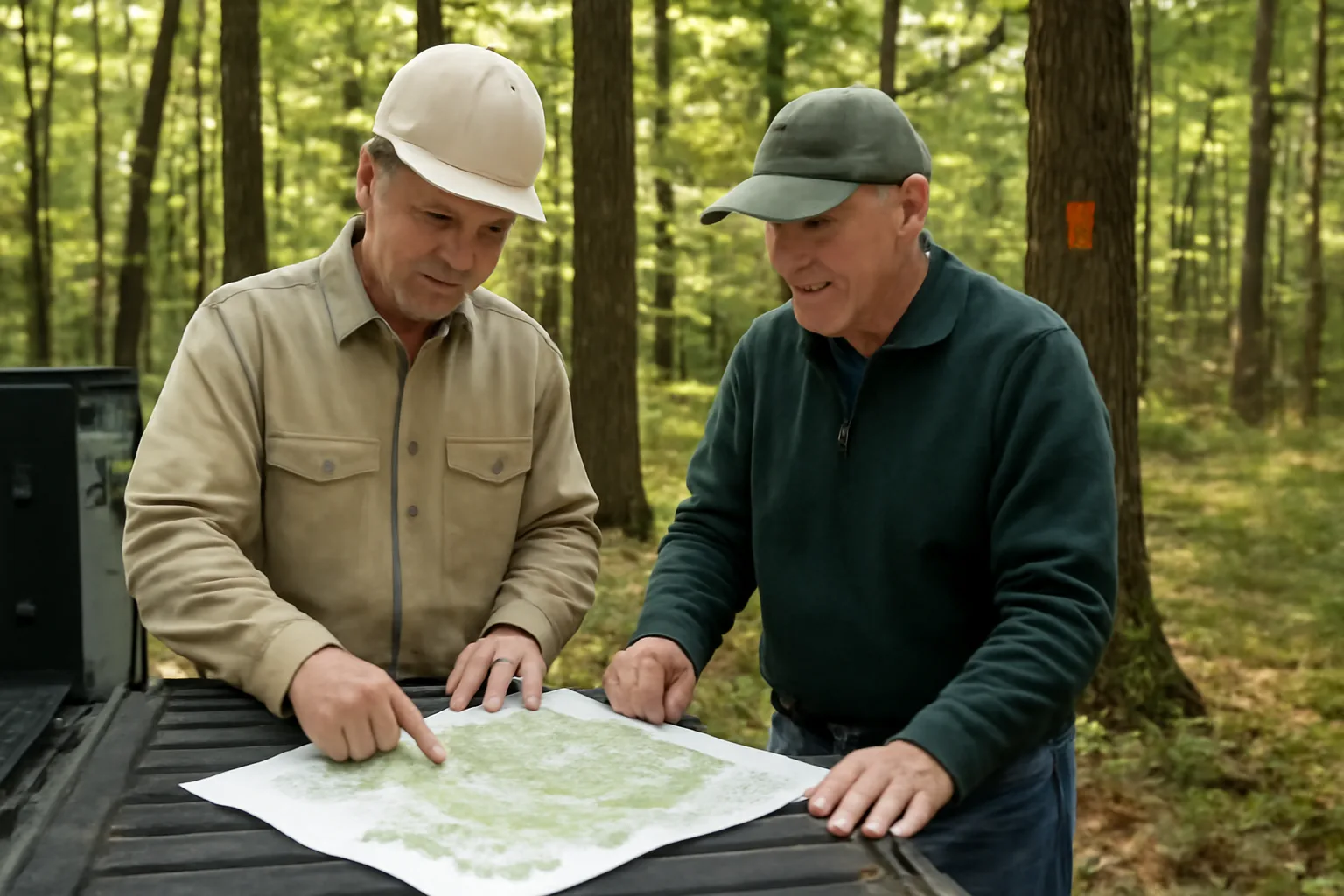
A forest management plan is a written, site-specific document that describes your land, your timber, and what you (or your forester) intend to do with it over time. Most plans run 10 to 30 pages for a property in the 10 to 100 acre range, though some state-mandated templates are shorter checklists and others (especially for certification programs) run much longer. A typical plan includes a property description with acreage, boundaries, and a soils map; a stand-by-stand inventory (species mix, age class, basal area, volume estimates); a set of landowner objectives (timber income, wildlife habitat, recreation, water quality, or some mix); a schedule of recommended practices (thinning, prescribed burns, timber stand improvement, harvest timing) tied to specific years; and a map showing stand boundaries, access roads, streams, and any wetlands or riparian buffers. Most state current-use and forest tax programs require a plan that meets specific content standards, sometimes called a "stewardship plan" or "forest management plan," and many require it be written or co-signed by a licensed or state-approved consulting forester. Vermont's Use Value Appraisal program, for example, requires a forest management plan that follows the state's official plan format and is updated every 10 years [1]. Check your own state forestry agency's current requirements before you commission one, because formats and renewal cycles differ by state and change periodically. If you're gathering documents before you approach a forester or apply for enrollment, our current-use enrollment kit organizes the property records, tax parcel data, and prior plan history a forester will ask for at your first site visit. It doesn't replace the forester's own plan or license requirement in states that mandate one; it just gets your paperwork in order before that meeting.
What is forest management, in plain terms?
Forest management is the practice of making deliberate decisions about a wooded property over time, thinning, harvesting, protecting water and soil, controlling invasive species, and regenerating stands, so the land keeps producing timber, wildlife habitat, and other benefits instead of just sitting untouched or getting cut once and left to whatever grows back. The U.S. Forest Service describes sustainable forest management as balancing "ecological, economic, and social values" across the life of a stand rather than optimizing for one harvest [2]. In practice for a small woodlot owner, that usually means periodic professional advice (a forester visit every 5 to 10 years), a written plan, and specific practices like commercial thinning, crop tree release, or prescribed fire depending on your forest type and region. Management is also the legal hook for tax relief. States that offer current-use or forest tax programs are trading a lower assessed value for your commitment to keep land in active, planned forest use rather than converting it to development or letting it go unmanaged. That's why the plan document matters so much: it's the proof of that commitment, and county assessors and state forestry offices audit against it.
What is a forest management bureau and what does it actually do?
A "forest management bureau" or "division of forestry" is the state agency office responsible for administering forest tax and stewardship programs, approving management plans, licensing consulting foresters, and auditing enrolled parcels for compliance. The exact name varies: Vermont calls its administering office the Department of Forests, Parks and Recreation [1], while other states use titles like "Bureau of Forestry" (Pennsylvania) or "Division of Forestry" (Ohio, Wisconsin). These offices typically handle four functions relevant to a landowner: reviewing and approving forest management plans submitted for current-use enrollment; maintaining a roster of state-approved or licensed consulting foresters; conducting periodic compliance inspections on enrolled parcels; and processing penalty or rollback tax assessments when land is withdrawn from the program or converted to a non-forest use. If you're not sure which office covers your county, start at your state's official forestry agency homepage rather than a general search; program rules, forms, and forester rosters are usually posted there directly, and the U.S. Forest Service maintains a directory of state forestry agencies as a starting point [3].
Why do current-use and forest tax programs require a management plan?
States require a written plan because it converts a vague promise ("I'll keep it as forest") into an enforceable, checkable document with dates, acreage, and practices attached. Without a plan, an assessor has no basis to verify that reduced-value land is actually being managed as forest rather than banked for a future subdivision. The plan also sets the compliance clock. Most programs require you to substantially follow the plan's schedule (a thinning in year 3, a regeneration harvest in year 15, and so on) and to update or renew the plan on a fixed cycle, commonly every 10 years. Missing scheduled practices, or converting the land to a non-forest use before the plan's commitment period ends, is what triggers rollback taxes and penalties in most states, a topic covered in more detail in our forest management guide. Because plan requirements, minimum acreage thresholds, and penalty structures vary by state and sometimes by county, always confirm current rules with your state forestry agency and county assessor before assuming a plan you've seen (including any sample) will satisfy your state's specific format.
What sections should a sample forest management plan include?
| Landowner objectives | Timber income, wildlife, recreation, aesthetics, water quality, ranked or weighted | |
|---|---|---|
| Property description | Acreage, legal description, access, adjoining owners, easements | |
| Site conditions | Soils, topography, hydrology, climate zone | |
| Stand inventory | Each stand mapped, with species composition, age, stocking, volume | |
| Management recommendations | Practice-by-practice schedule tied to specific stands and years | |
| Harvest schedule | Estimated timing and type of any planned timber harvests | |
| Wildlife and water protections | Riparian buffers, sensitive habitat, best management practices | |
| Maps | Aerial or topo map with stand boundaries, roads, streams | |
| Forester certification | Signature, license number, date, review/renewal date | Some states publish their own required template or checklist you can download directly from the forestry agency site rather than relying on a generic sample; using the state's own form (or having your forester use it) avoids a rejected application. For related definitions and how a plan interacts with land basis for tax purposes, see basis of land and timber management. |
A well-built plan generally covers the same core sections regardless of state, even though formats and required forms differ. Here's the structure most consulting foresters use, roughly mirroring state templates: | Section | What it covers |
Do you have to pay taxes on timber sales?
Yes. Timber sale proceeds are taxable income at the federal level, and in most states at the state level too, but the type of tax and the rate depend on how you held the timber and how the sale was structured. There's no blanket exemption for woodlot owners, current-use enrollment or not. The key distinction the IRS draws is between a lump-sum sale of standing timber (sold on the stump, before cutting) and a sale of cut products where you're paid based on volume removed. Most small landowners selling standing timber qualify to report the transaction as a capital gain rather than ordinary income, which usually means a lower tax rate, provided they've held the timber long enough and meet the requirements under Internal Revenue Code Section 631(b) [4]. Being enrolled in a state current-use program has no direct bearing on federal timber tax treatment; the two are separate systems (property tax relief at the state/county level versus income tax on the sale at the federal/state level). Don't assume enrollment changes your tax reporting obligations on a harvest.
How are timber sales taxed, capital gains or ordinary income?
Most lump-sum sales of standing timber held for investment or business use, and held longer than one year, qualify for long-term capital gains treatment rather than ordinary income tax rates. That distinction matters: long-term capital gains rates topped out at 20% federally as of the 2024 tax year, compared to ordinary income rates that can reach 37% [5]. Section 631(b) of the Internal Revenue Code specifically allows an owner who has held timber for more than one year before disposal to treat the gain from a sale, or from timber cut and disposed of under contract, as a capital gain [4]. The IRS's own guidance states that "gain or loss is capital if you owned the timber longer than 1 year before disposal" [6], which is the plain-language version of the rule. If you cut your own timber and use it in a business (a sawmill you also own, for instance) rather than selling standing timber to a buyer, the tax treatment gets more complicated and can trigger Section 631(a) rules instead. That's a scenario worth a session with a CPA who has actual timber tax experience, not a general preparer, before the harvest happens rather than after.
How do I report timber sales on my tax return?
For most landowners, timber sale income from land held as an investment gets reported on Form 8949 and Schedule D as a capital gain, using your adjusted basis in the timber (not the land) to calculate the gain. If you're claimed a depletion deduction or if the sale involved cutting under Section 631(a), you'll also need Form T (Forest Activities Schedule), though the IRS has waived the Form T filing requirement for many small, occasional-sale landowners in some years; check current instructions before assuming you're exempt . The basic math: proceeds from the sale minus your timber basis (what you or a prior owner allocated to standing timber value when the property was acquired) minus selling expenses (forester's cruise and marking fees, legal costs) equals your taxable gain. If you never established a timber basis separate from land basis at purchase, a consulting forester or timber tax specialist can often help reconstruct one using historical volume and price data, though it's far easier to do this at purchase than years later. Keep every document from the sale: the timber sale contract, the forester's cruise report, the closing statement, and any 1099 you receive from the buyer (timber buyers are generally required to issue Form 1099-S or 1099-MISC depending on the transaction structure). Report the sale in the tax year the timber was cut or the contract closed, not the year you signed the initial agreement, if those differ.
How do I avoid capital gains tax on a timber sale?
You generally can't avoid the tax entirely, but you can legally reduce it. The most common approaches are: using your timber basis to offset gain (most landowners underuse this because they never calculated a basis at purchase); spreading a large harvest across multiple tax years to stay in a lower capital gains bracket; using a Section 1031 like-kind exchange if you're selling the underlying timberland itself rather than just standing timber (rules here tightened after the 2017 Tax Cuts and Jobs Act, which limited 1031 treatment to real property); and claiming a casualty loss deduction if timber was lost to fire, storm, or insects rather than sold. Some landowners also use a qualified conservation easement donation to generate a charitable deduction that offsets other income, though that's a permanent land-use restriction, not a timing tool, and needs its own appraisal and legal review; it's not something to back into because of one big harvest year. There is no special federal exclusion just for "small landowner" timber sales the way there is a home-sale exclusion under Section 121. If a preparer tells you there's a blanket way to make timber gains fully tax-free, get a second opinion from a CPA who specializes in timber, ideally one referred by your state forestry association or extension forestry program.
How does a management plan affect timber sale timing and tax planning?
Your management plan's harvest schedule is also your tax planning calendar, because the year you cut or contract a harvest is generally the year the income is recognized. If your plan calls for a regeneration harvest in a single year, that can push a large lump sum into one tax bracket; some landowners work with their forester to phase a harvest across two calendar years instead, or time it around other income (a retirement year, a low-income year) to reduce the marginal rate on the gain. A plan also documents your basis-building history. If your forester's original cruise report assigned a timber value at the time you entered current-use, that number is a useful anchor for reconstructing basis later, especially if you never did a formal basis allocation at purchase. Ask your forester to keep dated cruise data as part of every plan update, more than at harvest time. None of this replaces the plan's core purpose, which is silvicultural, not tax-driven. But a forester who understands both the ecology and the tax calendar is worth more than one who only knows one side.
What happens if I sell timber without a written plan or while enrolled in current-use?
You can sell timber without a written management plan; the IRS doesn't require one for tax reporting purposes. But if your land is enrolled in a state current-use or forest tax program, the harvest almost always has to follow the plan's approved schedule and practices, or you risk a compliance violation, which can trigger rollback taxes and penalties even if the harvest itself was perfectly legal and well-managed. Rollback provisions vary widely: some states assess back taxes for as few as 3 years, others for 10 or more, plus interest, and some add a flat penalty percentage on top. This is state-specific and changes with legislation, so always confirm current rollback rules with your county assessor and state forestry agency before scheduling an off-plan harvest, and loop in your forester before, not after, if a harvest deviates from what's written. If you're not yet enrolled and are weighing whether a plan and enrollment make sense before your next harvest, our current-use enrollment kit at /current-use-kit-builder walks through the property and plan documentation most states ask for at application; it's a document organizer, not a substitute for the licensed forester's plan or legal advice on your specific parcel.
Do you pay taxes on timber sales if the land is enrolled in current-use?
Yes, enrollment in a current-use or forest tax program changes your property tax assessment, not your income tax obligation on timber sold from that land. The two systems are entirely separate and administered by different agencies: your county assessor and state Department of Revenue handle property tax and current-use compliance, while the IRS and your state income tax agency handle the tax on sale proceeds. Some states do apply a yield tax or stumpage tax specifically to timber harvested from enrolled land, in place of or in addition to standard tax treatment; this is a state-level excise on the harvest itself, separate from federal capital gains tax. Check your state's current-use statute or your state forestry agency's guidance for whether a yield tax applies in your county, since rates and even the existence of such a tax vary widely by state.
How does a forest management plan differ across states?
| Minimum enrolled acreage | Often 3 to 20 acres, varies widely | |
|---|---|---|
| Plan renewal cycle | Commonly every 10 years | |
| Forester requirement | Many states require licensed or state-approved forester signature | |
| Rollback penalty period | Ranges from 3 to 10+ years of back taxes, plus interest in most states | |
| Yield/stumpage tax | Present in some states, absent in others | Because every row in that table is genuinely state-specific and subject to legislative change, treat it as a checklist of questions to ask your state forestry agency and county assessor rather than as your state's actual rule. For a broader look at how programs differ, see our forestmanagement and forestry management guides. |
There's no single national plan template, and states differ on renewal cycles, forester licensing requirements, minimum acreage, and required content. Some comparison points worth checking directly with your state forestry agency before assuming a neighboring state's rules apply to you: | Feature | Common range across states |
Frequently asked questions
What is a forest management plan sample used for?
A sample plan shows the sections and level of detail a real plan needs, property description, stand inventory, objectives, and a practice schedule, so a landowner knows what to expect before hiring a forester. It's a reference for format only; most states require your actual plan be site-specific and, in many cases, prepared or signed by a licensed forester rather than adapted from a generic sample.
What is forest management bureau?
It's the common name for the state agency office that administers forest tax and stewardship programs, reviews management plans, licenses foresters, and audits enrolled land for compliance. Names vary by state (Bureau of Forestry, Division of Forestry, Department of Forests, Parks and Recreation); check your state's official site for the exact office covering your county.
What is forest management, exactly?
Forest management is the ongoing practice of planning and carrying out actions on wooded land, thinning, harvesting, regeneration, invasive species control, to sustain timber production, wildlife habitat, and water quality over time, rather than a single cutting event. The U.S. Forest Service frames it as balancing ecological, economic, and social values across a stand's full life cycle.
How do I report the sale of timber on my tax return?
Most landowners report timber sale gains on Form 8949 and Schedule D as capital gains, using the timber's adjusted basis to calculate gain, and may need Form T (Forest Activities Schedule) depending on the transaction type. Report in the year the timber was cut or the sale closed. Confirm current Form T filing thresholds with the IRS before assuming you're exempt.
How do I avoid capital gains tax on a timber sale?
You generally can't eliminate it, but you can reduce it: use your timber basis to offset gain, spread a large harvest across tax years, consider a 1031 exchange if selling land itself, or claim a casualty loss if timber was lost to fire or storm rather than sold. There's no blanket small-landowner exemption comparable to the home-sale exclusion.
Do I have to pay taxes on timber sold from my land?
Yes. Timber sale proceeds are taxable at the federal level and usually at the state level, regardless of whether the land is enrolled in a current-use property tax program. The type of tax depends on how the sale is structured; most standing timber sales held over a year qualify as long-term capital gains under IRC Section 631(b).
Do you have to pay taxes on timber sales even if you're not a commercial logger?
Yes, occasional or one-time timber sales by individual landowners are still taxable income. The IRS treats a lump-sum sale of standing timber held over one year as a capital gain regardless of whether the seller runs a timber business, though the specific forms and depletion rules differ for investment-only owners versus timber businesses.
Do you pay taxes on timber sales differently if enrolled in current-use?
Current-use enrollment affects your property tax assessment, not your income tax on timber sale proceeds; those are separate systems. Some states apply a separate yield or stumpage tax on harvests from enrolled land. Check your state's current-use statute for whether that applies in your county.
How are timber sales taxed compared to ordinary income?
Most standing timber sales held longer than one year qualify for long-term capital gains rates, which topped out at 20% federally for 2024, versus ordinary income rates reaching up to 37%. Timber cut and used in your own milling business can trigger different rules under IRC Section 631(a); get a timber-specific CPA opinion before a large harvest.
How to report timber sales on a tax return if I received a 1099?
Use the 1099 (typically 1099-S or 1099-MISC depending on how the buyer structured payment) as a starting point, then calculate your gain by subtracting your timber basis and selling costs from gross proceeds, reporting the net gain on Form 8949 and Schedule D. Keep the sale contract and forester's cruise report as backup documentation.
Does a forest management plan need to be renewed?
Most state current-use programs require plan renewal on a fixed cycle, commonly every 10 years, though the exact interval and renewal process vary by state. Vermont's Use Value Appraisal program, for example, requires updated plans on a 10-year cycle. Confirm your state's specific renewal requirement with your state forestry agency well before the deadline.
Do I need a licensed forester to write my management plan?
Many states require a licensed or state-approved consulting forester to prepare or sign the plan submitted for current-use enrollment, though requirements vary. Some states allow landowner-prepared plans for smaller acreages. Check your state forestry agency's current-use program page for the specific requirement before commissioning a plan.
Sources
- USDA Forest Service, State and Private Forestry: Directory and overview of state forestry agency programs for private landowners
- 26 U.S.C. Section 631, Cornell Legal Information Institute: Section 631(b) allows capital gains treatment for timber held more than one year before disposal
- IRS, Topic no. 409, Capital Gains and Losses: Long-term capital gains rates for 2024 top out at 20% federally
- IRS, Publication 225, Farmer's Tax Guide (timber section): Gain or loss on timber is capital if owned longer than one year before disposal
- IRS, Instructions for Form T (Timber): Form T (Forest Activities Schedule) reporting requirements and exceptions for occasional timber sellers
- USDA Forest Service, National Woodland Owner Survey: Data on private woodland ownership patterns and management plan prevalence among small landowners